
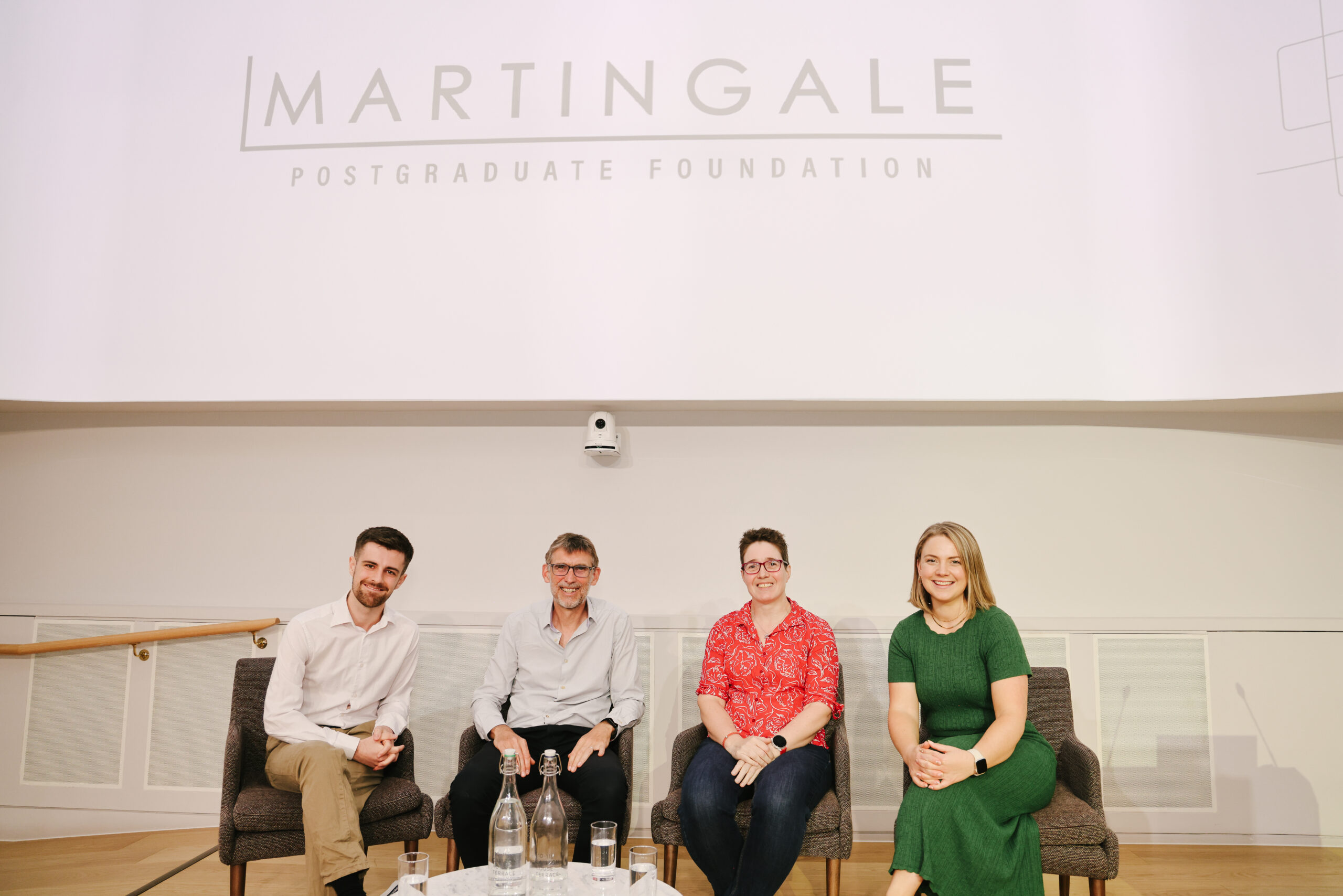
Cassandra Hugill, Chief Executive of the Martingale Foundation gave an insightful speech at our recent event: Finding Hidden Talent, addressing the barriers to postgraduate study and the importance of investment across the pipeline for innovative talent to thrive and succeed.
“Welcome everyone and thank you for joining us. I’m Cassie Hugill, Chief Executive of the Martingale Foundation and we are delighted to have you here with us this evening.
At Martingale, we believe that brilliance is everywhere, but opportunity is not. We strive for a world where everyone with the talent and drive to pursue postgraduate research has the means to do so, regardless of background. Through this, we unlock potential, supporting students from low-socioeconomic backgrounds to thrive in academia, innovate boldly, and help solve the world’s most pressing challenges.
The UK has long been a powerhouse in global research and higher education. Our universities attract world-class minds, and our innovations, from the discovery of DNA structure to the development of the COVID-19 vaccine, have had a global impact.
But despite this proud history, we are now at a critical juncture. For the first time in five years, the UK has slipped in the Global Innovation Index. This signals a warning. Innovation is not inevitable; it must be nurtured.
Research and innovation are the engines of economic growth, scientific progress, and global problem-solving. At the heart of this work are PhD students, the next generation of researchers who bring new ideas, energy, and perspectives to our labs, universities, and industries.
UKRI stipends for PhD students will be increasing by 8% from October 2025, the largest increase since 20031. This is a welcome change that will benefit all PhD students as many base their stipends on the UKRI rate, however it must be acknowledged that without an increase in the size of the envelope available to UKRI PhD programmes, it has further reduced the number of PhD places available.
Since 2018, there has been a 28% decline in the number of PhD students funded by UKRI2. In the same period, UK student enrolment in full-time postgraduate research degrees dropped by 8%, with 4% of that fall happening just in the past year3.
While many may attribute this drop to a lack of funding, which is a factor, it is not the only factor. Academics are reporting difficulties in attracting domestic PhD candidates even when funding is available. The reality is that academia is not as appealing as it once was, and many are electing to go where opportunities appear more accessible and financially secure.
This leaves a gap in supply, with the demand for PhD-level talent remaining strong, both within academia and across sectors like biotech, engineering, AI, and consulting. And the payoff is real: PhD graduates earn on average 22% more than those with a bachelor’s degree alone4.
So what’s going wrong? Could it be that students aren’t choosing the right subjects or pathways early enough to allow for postgraduate progression?
Not quite. The UK continues to see strong demand for university education. In fact, Tony Blair’s target of getting 50% of young people into higher education was achieved in 2017. And thanks to tireless efforts by social mobility charities and universities, university participation among students from the most deprived areas has more than doubled growing from 11% to 24% in just a decade5.
This is good news. But the pressure remains. As demand for highly-skilled graduates continues to rise, particularly in fields like engineering, healthcare, and education, we’ll need over 11 million graduates by 2035. And with the rise of AI and advanced technologies, the demand for jobs in AI and related areas requiring degrees will grow by 10% in just two decades6.
We have the talent. But we need to invest in it – at all levels. For many, the cost of pursuing postgraduate study is simply out of reach.
In 2022/23, more than a third of UK households (36%) were living below the minimum income standard of £29,5007. At the same time, Master’s tuition fees have surged by 43% over seven years, but government loan provisions have not kept pace. In fact, in 2024, for the first time, the average tuition fee for a Master’s surpassed the loan available to pay for it8.
This financial pressure is forcing talented individuals to abandon research ambitions. And the data is stark: students from low socioeconomic backgrounds are 8 times less likely to pursue a Masters and 15 times less likely to pursue a PhD compared to their most privileged peers9.
That’s why Martingale exists.
We are here to remove the barriers that block brilliant minds from pursuing advanced study and research. Because this isn’t just a personal loss – it’s a loss for all of us.
Diverse teams create better outcomes. Research shows that diverse teams generate 11% more citations10, and companies with diverse leadership are 25% more likely to enjoy higher profits11. Supporting talent isn’t just the right thing to do – it’s smart strategy for innovation, growth, and impact.
At Martingale, we tackle this problem across three critical areas:
Hidden Curriculum – We know there is a significant barrier before a student even applies for a postgraduate degree. That’s why we do things a bit different. We recruit candidates before they apply to the university, offering over seven hours of support per candidate from webinars, proofreading, interview training and a PhD showcase to ensure they are able to deftly navigate the systems and processes required. Our goal is to place highly talented people in the right university for them, but also provide students that are right for the university. It’s important to have both for a programme like ours to thrive.
Funding – We provide scholarships that cover tuition fees, a living wage stipend, and research costs for Martingale Scholars. This is no small feat, and thanks to our generous donors, we have already committed over £7.4m in funding since our launch in August 2022.
System Change – Our Postgraduate Scholarship Programme is impactful, and we are proud to be supporting over 110 Scholars to date. But we also know that we are limited in how many talented people we can support directly. That’s why we are working with universities and policymakers to identify, understand and transform access and progression in the academic pipeline, supporting all students to thrive – not just those we fund.
And it’s working. In just a short three years, we’ve partnered with ten leading universities, supported a growing cohort of outstanding scholars, and created real momentum.
And we are just getting started. Our ambition is to grow our Postgraduate Scholarship Programme across STEM, focusing on the high demand areas of Biomedical Sciences, Computer Science (particularly AI), Engineering and Mathematics. By 2030, we have set ourselves the high target of welcoming 200 new Scholars each year.
Alongside this, we plan to grow our work in policy and advocacy, supporting the sectors understanding of the inherent challenges people from low-socioeconomic backgrounds face. We will advocate and support our partners and the wider sector to make feasible changes to ensure that family income is never a barrier to the pursuit of excellence.
But we cannot do it alone, we need support from organisations and individuals across the research and innovation landscape to make our vision a reality. So please, help us spread the word, advocate and connect us, and if you are in a position to do so, join us.
We are so grateful to our ten university partners, the many academics and professional services staff who help make it happen, our founding donor XTX Markets and AI partner Google DeepMind, our incubator Purposeful Ventures who enable us to be bold and ambitious in our growth and the many organisations and supporters who are helping us build a better, fairer system. Together, we are unlocking potential, fuelling innovation, and ensuring that brilliant minds are focused on the future for research, discovery, and the world.”
There are a variety of ways to get involved in Martingale’s mission, supporting the next generation of talented researchers. If you are interested in learning more about these opportunities, please get in touch!
- UKRI (2025), UKRI is increasing PhD stipends and improving student support
- Times Higher Education (2023), Domestic students squeezed out as UKRI PhD support contracts
- Financial Times, Share of domestic postgraduate researchers hits record low in England
- Research England (2024), A review of the economic and social value produced through funding PhD students
- The Sutton Trust (2023), 25 Years of University Access
- Universities UK (2023), Jobs of the future
- Joseph Rowntree Foundation (2023), Households living below a Minimum Income Standard: 2008–2023
- Times Higher Education (2024), Average master’s fee higher than postgraduate loan for first time
- Institute for Fisal Studies (2020), Family background and access to postgraduate degrees
- The preeminence of ethnic diversity in scientific collaboration, AlShelbi et al., Nature Communications, 2018
- McKinsey & Company (2015), Diversity Wins. How Inclusion Matters